
A football on a dark plinth under a single spotlight on an empty awards stage

Ballon d’Or Winners: The Full List of Men’s and Women’s Champions

The Ballon d’Or has been handed out since 1956 and remains the most discussed individual prize in football. It is not awarded by a governing body or decided by a points table, which is exactly why the result is argued over every autumn.

This page lists the winners, sets out the voting method, and notes the records that shape the debate.

The 2026 awards

The 70th ceremony was held on 26 October 2026 at the London Palladium, the first time the event has taken place outside France. It was staged in London in recognition of Sir Stanley Matthews, who won the inaugural award in 1956.

AwardWinner
Men’s Ballon d’OrHarry Kane (Bayern Munich and England)
Women’s Ballon d’OrAlexia Putellas (Barcelona and Spain)
Men’s Kopa TrophyLamine Yamal (Barcelona)
Women’s Kopa TrophyVicky López (Barcelona)
Men’s Yashin TrophyUnai Simón (Athletic Club)
Women’s Yashin TrophyCata Coll (Barcelona)
Men’s Gerd Müller TrophyHarry Kane
Women’s Gerd Müller TrophyCharlyn Corral (Pachuca)
Sócrates AwardBukayo Saka (Arsenal)
Men’s Club of the YearParis Saint-Germain
Women’s Club of the YearBarcelona
Men’s Coach of the YearLuis de la Fuente (Spain)
Women’s Coach of the YearPere Romeu (Barcelona)
Full list of category winners from the 2026 ceremony.

Kane finished ahead of Kylian Mbappé and Lamine Yamal to win his first Ballon d’Or, and also collected the Gerd Müller Trophy as the leading scorer. Putellas won the women’s award for the third time, having previously taken it in 2021 and 2022. Charlyn Corral became the first Mexican player to win any award at the ceremony.

Men’s winners since 2010

YearWinnerClub at the time
2026Harry KaneBayern Munich
2025Ousmane DembéléParis Saint-Germain
2024RodriManchester City
2023Lionel MessiInter Miami
2022Karim BenzemaReal Madrid
2021Lionel MessiParis Saint-Germain
2020Not awardedCancelled during the pandemic
2019Lionel MessiBarcelona
2018Luka ModrićReal Madrid
2017Cristiano RonaldoReal Madrid
2016Cristiano RonaldoReal Madrid
2015Lionel MessiBarcelona
2014Cristiano RonaldoReal Madrid
2013Cristiano RonaldoReal Madrid
2012Lionel MessiBarcelona
2011Lionel MessiBarcelona
2010Lionel MessiBarcelona
2020 is the only year since 1956 with no winner.

Most men’s awards

  1. Lionel Messi, eight (2009, 2010, 2011, 2012, 2015, 2019, 2021, 2023)
  2. Cristiano Ronaldo, five (2008, 2013, 2014, 2016, 2017)
  3. Michel Platini, Johan Cruyff and Marco van Basten, three each

Messi and Ronaldo won thirteen of the sixteen awards between 2008 and 2023, a concentration with no parallel in the prize’s history. Since Messi’s last win the award has gone to four different players in four years.

The women’s award

The women’s Ballon d’Or began in 2018. Ada Hegerberg won the first, Megan Rapinoe took the 2019 edition, and the award has gone to a Spanish player every year since 2021.

YearWinner
2026Alexia Putellas
2025Aitana Bonmatí
2024Aitana Bonmatí
2023Aitana Bonmatí
2022Alexia Putellas
2021Alexia Putellas
2019Megan Rapinoe
2018Ada Hegerberg
The 2020 women’s award was also cancelled.

Bonmatí’s three consecutive wins from 2023 to 2025 and Putellas’s back-to-back awards before them mean Barcelona players have dominated the prize since its early years.

How the voting works

The award is run by the magazine France Football, now alongside UEFA. Journalists vote, with the size of the panel tied to national rankings: the men’s award draws on one voter from each of the top hundred countries, the women’s from the top fifty.

Each voter submits a ranked list of players. Points are allocated by position on those lists, and the totals are published afterwards, which is how the gaps between finishers become public. Voters are asked to weigh individual performance, team achievement, and conduct, over a season rather than a calendar year.

That last change matters for any comparison across eras. Awards up to 2021 covered a calendar year, so a player could be rewarded for half of one season and half of the next.

Why the result is always contested

There is no formula. A journalist weighing a prolific scorer in a league of moderate strength against a midfielder who controlled a Champions League campaign is making a judgement, not a calculation, and a hundred such judgements rarely align neatly.

Records set elsewhere are easier to settle. Our list of the all-time Grand Slam singles leaders shows what a sport looks like when the honours board is decided purely on the field.
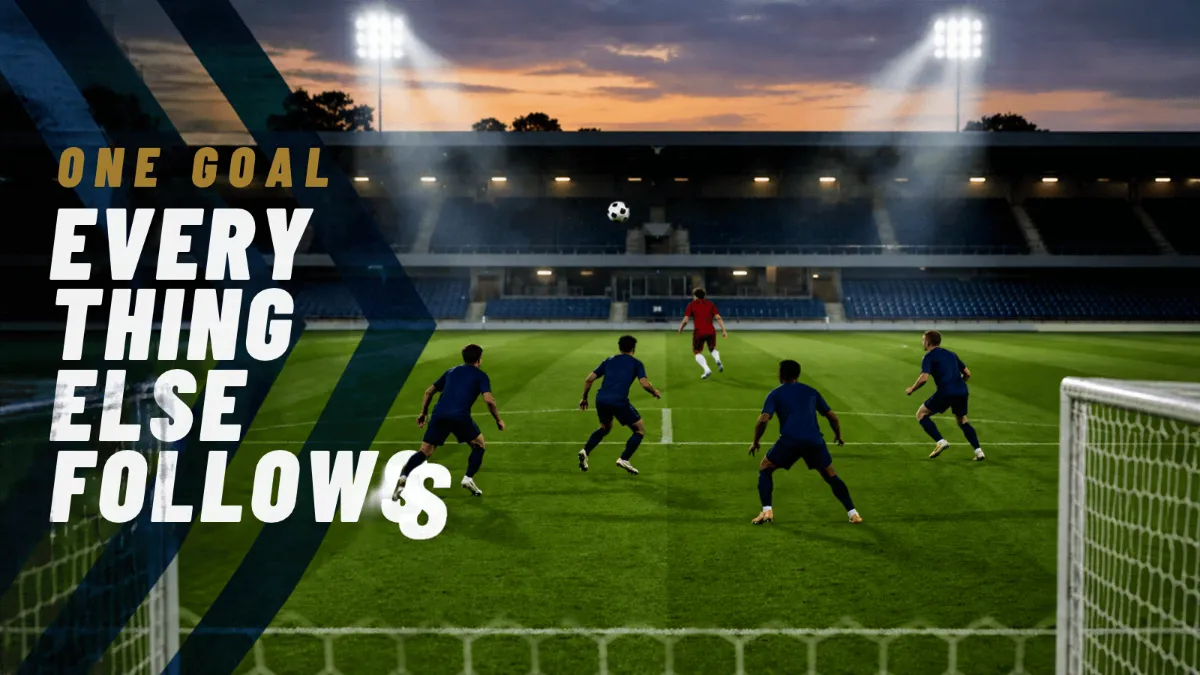
A defensive line of footballers spread across the pitch with an attacker running beyond them and the ball in flight

The Offside Rule in Football, Explained With Clear Examples

Offside is the one law that decides goals every weekend and still gets argued about in living rooms. Most of the confusion comes from treating it as one rule when it is really a sequence of tests, all of which have to be passed before a flag goes up. Get the sequence straight and the decisions stop looking arbitrary.

What follows is Law 11 of the Laws of the Game in ordinary language, with the parts that catch people out set out separately.

The three conditions, all of which must be true

A player is only penalised for offside when every one of the following holds. Miss any single one and there is no offence.

  1. Position. At the moment the ball is played by a teammate, the player is in the opposition half and closer to the opposition goal line than both the ball and the second-last opponent. The goalkeeper is usually one of those two opponents, but not always.
  2. Timing. The position is judged at the instant the ball is touched or played by the teammate, not when the player receives it. A player can be yards beyond the defence when the ball arrives and still be onside if they were level when it was struck.
  3. Involvement. Being in an offside position is not an offence in itself. The player must then become involved: by playing or touching the ball, by interfering with an opponent, or by gaining an advantage from having been in that position.

That third condition is the one that produces the long pauses. A striker standing beyond the last defender who makes no attempt to play the ball and does not obstruct the goalkeeper has committed nothing, and play simply continues.

What counts as interfering with an opponent

The law is specific rather than open to taste. A player in an offside position interferes with an opponent by blocking their line of vision, by challenging them for the ball, by making an obvious action that clearly affects their ability to play the ball, or by an attempt to play a ball that is close enough to impact an opponent.

When a player is level

Level is onside. If any part of the attacker that can legally score is in line with the second-last opponent, there is no offside position at all. In practice that means the hands and arms are excluded from the measurement for both the attacker and the defender, because neither can legally play the ball with them.

This is why the lines drawn on television are placed on a shoulder or an armpit rather than a fingertip, and why two decisions that look identical on a still frame can go different ways.

The exceptions worth remembering

Four situations are not offside regardless of where anyone is standing.

SituationWhy there is no offence
Receiving directly from a goal kickThe law exempts goal kicks outright
Receiving directly from a throw-inThe law exempts throw-ins outright
Receiving directly from a corner kickThe law exempts corner kicks outright
In your own half when the ball is playedPosition is only judged in the opposition half
The three set-piece exemptions apply only to the first touch after the restart.

There is a fifth case that is not an exemption but behaves like one. If the ball is deliberately played by an opponent, rather than deflected off them, any offside position is wiped and the attacker is free to play on. A defender who makes a controlled clearance into the path of a striker has given the ball away, not created an offside.

A save is treated differently. If a goalkeeper or defender makes a deliberate save and the ball falls to an attacker who was in an offside position, the offence still stands.

How the call is judged now

The assistant referee is instructed to delay the flag when a goalscoring situation is developing, so that a wrongly flagged goal is not lost. If the attack ends in a goal, the position is then reviewed.

Reviews work from the frame in which the ball was played and a measurement of the attacker against the second-last defender. Semi-automated systems use limb tracking to pick that frame and those points automatically, which has cut the time taken rather than removed the judgement involved, since the kick frame itself still has to be identified.

Three misunderstandings that will not go away

  • “He was behind the defender when he scored.” Irrelevant. Only the position when the pass was played matters.
  • “The goalkeeper was off his line, so it cannot be offside.” The measurement is against the second-last opponent, whoever that is. If the keeper has advanced, an outfield defender becomes the reference point.
  • “He was offside but did not touch it.” Possibly no offence. Touching the ball is only one of three ways of becoming involved, and if none of them happened, play continues.

A quick way to check any decision

Run the three conditions in order. Was the player in an offside position at the moment the ball was played? If no, stop. If yes, did they become involved? If no, stop. If yes, did the ball come from a goal kick, throw-in or corner, or from a deliberate play by an opponent? If yes, stop. Only if the sequence runs all the way through is it offside.

For more on how officials reach decisions in other sports, our guide to kabaddi rules and scoring covers a code with its own version of a line you cannot cross.